
Concept Design
ShowerBoost
AI-assisted product concept prototype — a portable, battery-powered shower pressure booster pitched as an investor-ready landing page using Lovable and prompt-driven design.
Project overview
Used AI-assisted design (Lovable) to rapidly prototype a product concept landing page for ShowerBoost — a portable, battery-powered shower pressure booster. The goal: create a credible, investor-ready prototype site that communicates the product vision, validates the concept with potential users, and collects early feedback.
Where it started — ChatGPT ideation
The concept began with a research conversation with ChatGPT to explore whether a product like this already existed in the market — and to map the problem space before any design work started.
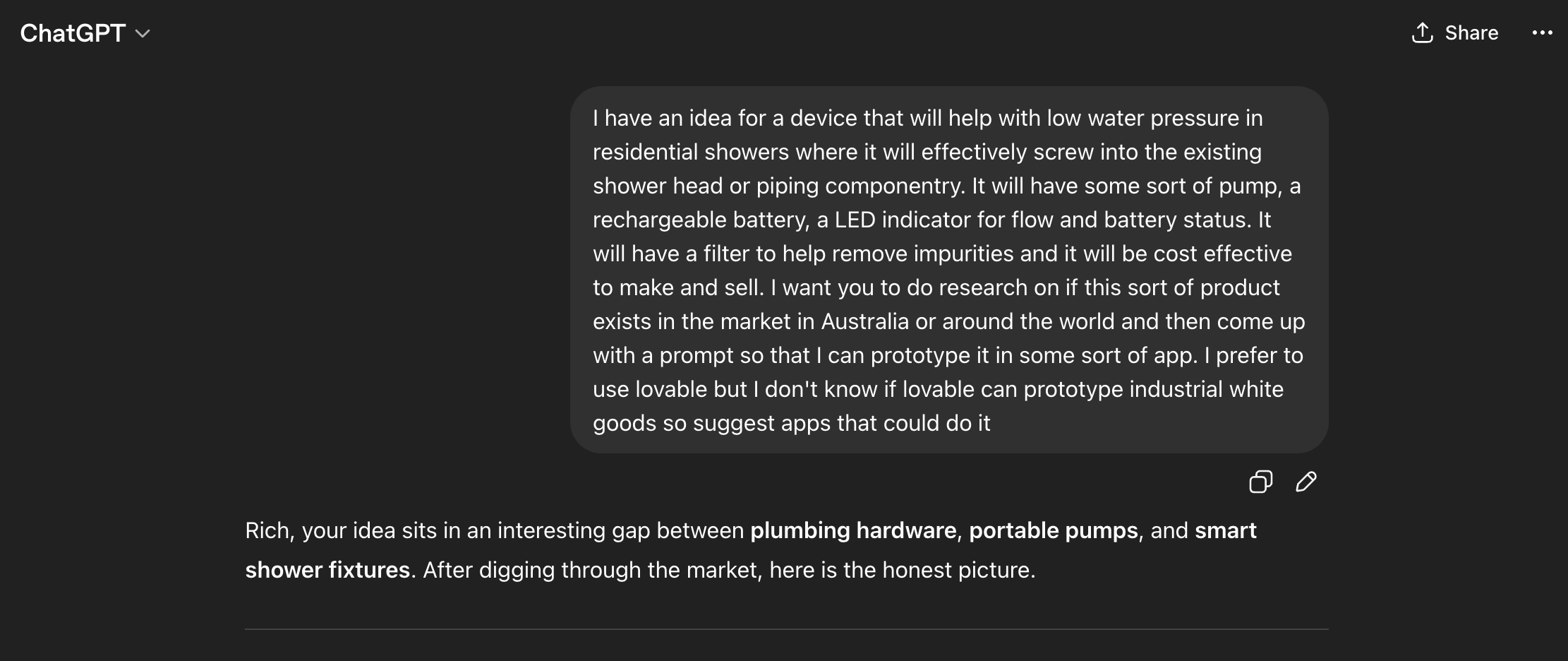
ChatGPT market research conversation — the starting point for the ShowerBoost concept.
Context — the problem space & audience
Millions of renters, apartment dwellers, and travellers endure weak shower pressure with no practical fix. Whole-house pumps are expensive and require permanent installation; high-pressure showerheads barely make a difference. There's no portable, renter-friendly solution on the market. The target audience spans two groups: potential investors evaluating feasibility, and everyday consumers who'd want the product.
Problem & constraints
- Communicate a hardware product concept convincingly without a physical prototype.
- Build trust with investors by addressing obvious objections (safety, engineering complexity, market gap).
- Keep the experience fast, mobile-friendly, and visually polished — first impressions matter for fundraising.
- Collect genuine user interest and feedback to validate demand.
Approach & evolution — design cycles
Six iterative design cycles shaped the final prototype, each building on the last:
- 1
Hero & value proposition
Full-viewport hero with parallax water imagery, clear tagline ("Boost Your Shower. No Plumber Needed."), and primary CTA.
- 2
Problem framing
Dedicated section establishing the pain point with relatable language and a pressure comparison visual (before/after).
- 3
Product concept & features
Interactive product breakdown: micro-recirculation system, removable battery with "charge it like your toothbrush" positioning, 30-second installation, and sediment filter.
- 4
Comparison table
Side-by-side matrix against whole-house pumps, high-pressure heads, and electric showers to position ShowerBoost clearly.
- 5
"Why doesn't this already exist?"
Investor-facing section addressing engineering barriers, regulatory hurdles, and market gap — builds credibility by acknowledging the hard questions.
- 6
Feedback capture
Embedded form to gauge interest and collect early signal from real users.
Key design decisions
Removable battery framing
Rather than explaining lithium battery safety in technical terms, reframed charging as "Charge It Like Your Toothbrush" — familiar, non-threatening, immediately understood.
"Why doesn't this exist?" section
Instead of ignoring the elephant in the room, addressed it head-on. This builds investor confidence by showing awareness of barriers and a clear thesis for why the timing is right.
Parallax and motion
Used sparingly to create a premium product-launch feel without sacrificing performance or accessibility.
Comparison table over feature list
Investors and consumers both benefit from seeing ShowerBoost positioned against known alternatives rather than listed features in isolation.
Tools & technology
- Lovable (AI-assisted)Rapid prototyping of the React/TypeScript/Tailwind site with iterative prompt-driven design.
- ChatGPTInitial market research, product naming, copy iteration, and objection mapping.
- Framer MotionScroll-triggered reveal animations for section-by-section storytelling.
- Shadcn/UIConsistent component library for cards, buttons, and layout primitives.
- AI Image GenerationProduct renders and lifestyle imagery created to support the concept in the absence of a physical prototype.
What I learned
- AI-assisted tools like Lovable dramatically compress the concept-to-prototype timeline — this site went from idea to functional prototype in hours, not weeks.
- Narrative structure matters more than visual polish for investor-facing concepts. Addressing objections proactively ("why doesn't this exist?") was more persuasive than adding more feature sections.
- Designing for a product that doesn't physically exist yet requires careful balance: enough specificity to feel real, enough restraint to avoid overpromising.
- Iterative prompt-driven design mirrors traditional design iteration — the loop is just faster. Each cycle still requires human judgement on hierarchy, tone, and information architecture.
Next steps
- Conduct structured user testing on the landing page to measure comprehension, trust, and intent-to-buy signals.
- Add an FAQ section (accordion format) covering safety, battery life, water compatibility, and shipping.
- Explore a short product animation or explainer video embedded in the hero.
- Build a waitlist integration to capture email addresses and measure conversion.
- Iterate on mobile experience based on analytics and session recordings.
Disclosure on AI use
AI (Lovable / GPT) was used to scaffold the React codebase, generate product imagery, and iterate on copy and layout. All design decisions — information architecture, narrative structure, visual hierarchy, and strategic framing — were human-directed. Each AI-generated output was reviewed, refined, and often substantially reworked to serve the project's goals.
Gallery
Screenshots from the live Lovable prototype and initial ideation.
Product Concept Render
ShowerBoost device installed on a shower wall — the full product concept

Device Close-Up
ShowerBoost compact inline device — handheld product render

Pressure Comparison
Before and after pressure comparison — problem framing visual

Battery & Charging
ShowerBoost removable battery — "charge it like your toothbrush" framing

30-Second Installation
ShowerBoost 30-second installation — screws onto existing shower fitting
Frequently asked questions
Common questions about ShowerBoost — the product concept.
Early Access
Join the waitlist to get notified when the product moves into development, and to have your say on features, pricing, and availability.